Asia
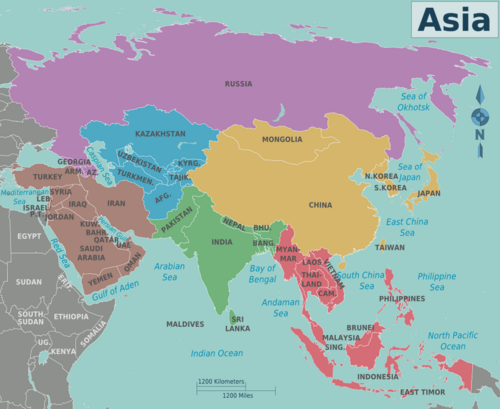
I'm going to talk about Asia. Asia stretches about 5,000 miles from north of the
Arctic Circle to south of the equator. From east to west Asia stretches nearly
halfway around the world. This area has many different kinds of climate.
Asia has some of the coldest and some of the hottest, some of the wettest and
some of the driest places on earth. In southern Asia the climate is quite different.
Here is is hot all year round, except in the mountains. The temperature in the
lowlands may reach as high as 125 degrees. There are no summer and winter as we
know them. Instead, there is a rainy season and a dry season. Asia is the world's most populous continent and is the largest too. Asia covers about 8.6% of the entire earth's earth's surface area. It has a population of about 4 billion people and is about 17,212,000 square miles in size. The populations in Asia is 3,3879,000,000. Biggest continent in the world. The highest mountain Mt Everest is in Asia.
Global Issue about food in Asia
Asia and the Pacific region is expected to
see pressures on the ecosystem and competition for freshwater resources
due to rising food production, as well as changing precipitation
patterns and increased flooding due to climate change. A rise in food
prices can impact purchasing power of households dramatically: a recent
ADB study estimates that a 10% increase in domestic food prices in
developing Asia could push 64.4 million people into poverty based on a
$1.25-a-day poverty line.
How Asia and the Pacific region
manages food security issues, both reactivate and proactively, will be
critical to ensuring sustainable, inclusive economic growth and social
cohesion. Asia does not have a lot of food issue.
Climate action network south Asia
what is a climate action network south asia well its Organize, support, inspire and co-ordinate its members to take effective action on climate change, as one global voice, in regions, nations and communities. And it Protect the global climate from dangerous human Services. Asians are ruining the world with their pollution.
China
Government they're communist which they tell you what to do and when to do it and they can be very rude to people that give them hard times. They have alot of people in china and you can only have one kid and if you have more then one kids then they well kill them or maybe take them away from the family and put the child somewhere else. China is a big country and they have a lot of food i mean a lot and they china make clothes and stuff for the USA which is nice. but china is a very hard place to live because there are so many rules there and to crowed and people get sick a lot because there people everywhere.
Japan
The government Japan is a constitutional monarchy where the power of the emperor is limited, relegated primarily to ceremonial duties. Japan has joined the UN in 1956 and has been active in its activities since then, especially in the social and economic activities. About 11% of UN budget is Japan's contribution, which definitely is greater than that of many permanent members. It has taken part in the peace keeping operations of the UN in Afghanistan, Iran and Iraq. It is active in the developmental activities of the UN and is a contender for permanent membership in case a reform of the UN takes place. The Japanese people of today seem to have had ancestors that came from several places. Although in antiquity the mountainous islands were once connected to the mainland, after the last Ice Age, the waters rose, isolating the island group. Whatever the origins of the earliest inhabitants were, some groups may have come from nearby Siberia, the Korean peninsula, the Yellow River and Yangzi River areas of present-day China and the southern chain of islands that lead down into Polynesia. By at least 300 BC, significant populations with advanced metal technology, rice agriculture, and horses began arriving from the Korean peninsula, and the dates of such migrations may yet be pushed back farther. As culture developed in Japan, there were several periods when archaeological and historical evidence point to the rapid introduction of cultural elements from other places. These cultural borrowings were subsequently “re-made” in Japan to fit local needs and tastes. In some periods, cultural borrowing proceeded in a systematic matter, with definite goals in mind. This process of controlled selection and adaptation was enhanced by the island nature of the country. The Age of Reform (552-710 AD), the Meiji Period (1868-1912), and the decades right after WWII. They grow rice, sugar beets, vegetables, fruit; pork, poultry, dairy products, eggs; fish.

|
China Hack.docx Size : 12.969 Kb Type : docx |
|
|
North Korea Nuke.docx Size : 13.64 Kb Type : docx |
